
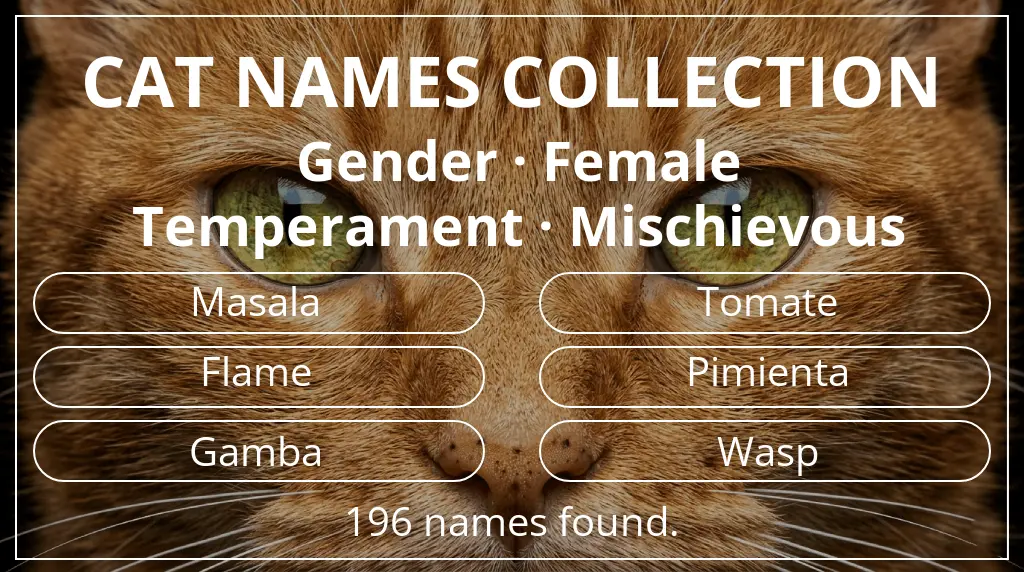
Cat names related to female gender and mischievous temperament
Each name in this list has been picked to fit the traits you care about. Scroll through the selection and bookmark your favorites — the right name is just a scroll away.
About their personality: Cheeky cats ensure life interesting with their cunning antics — enjoy constant amusement from your furry rascal. A mischievous streak brings comic relief to your routine, making your pet the undoubtedly amusing member of the family. Your feline friend deserves a unique name; explore our 196 enchanting suggestions today. Gender and naming: From tender to fierce, girl pet names offer lovely variety for every personality type. Female names tend to be refined and delightful, reflecting the beauty of your pet.
- Temperament: MischievousGender: Female
Pimienta
Spanish word for 'pepper' or 'peppercorn'. Derived from the Latin 'pigmenta' ('pigment/dye').Habanero
One of the most intensely hot chili peppers. The Spanish name means ''from Havana'' (Cuba), where it may have been traded.Mustard
English word for the condiment and seeds. Derived from Old French 'moustarde', referring to the 'must' (fermented grape juice) used in preparation.Remolacha
Spanish word for 'beet' or 'beetroot'. Derived from the Latin 'beta'.Bronze
A yellowish-brown alloy of copper and typically tin. Also a dark golden-brown color. Possibly derived from the Latin 'aes Brundisium' ('''ore of Brindisi''').Ruby
The name of the red gemstone, derived from the Latin 'rubeus' meaning 'red'. Often given to pets with reddish coats.Express
English word meaning 'moving at high speed'. Derived from the Latin 'exprimere' ('press out').Kimchi
Traditional Korean side dish of salted and fermented vegetables, most commonly napa cabbage and Korean radishes.Planet
A celestial body moving in an elliptical orbit around a star. Derived from Greek 'planētēs' ('''wanderer''').Pogo
A type of bouncing stick or jump. Likely an arbitrary coinage, famous as the name of a classic comic strip.Mojito
A Cuban cocktail made with white rum, sugar, lime juice, soda water, and mint. The name is believed to come from the Spanish word 'mojo', referring to a Cuban lime marinade.Inky
An adjective meaning '''resembling ink''', often used to describe a dark black or deep purple color.Wiggle
English word meaning 'move or cause to move with small rapid movements'. Related to the German 'wiegen' ('to rock').Elf
In Germanic mythology, a supernatural being or spirit. Implies magic, small stature, or mischief. (E.g., Buddy the Elf).Tatsumaki
Japanese word meaning 'tornado' or 'whirlwind'.Kitsune
The Japanese word for '''fox'''. In folklore, Kitsune are ''magical foxes'' with shifting abilities and multiple tails. Name means '''fox'''.Fizz
English word for the sound of escaping gas, often from carbonated drinks. Implies high energy and excitement.Spider
Directly refers to the arachnid, heavily associated with the superhero Spider-Man (Marvel Comics).Wiggles
English word meaning to move or cause to move with small, rapid movements. Implies restlessness and high energy. (Also an Australian children's music group).Yolo
An acronym for ''You Only Live Once'', a phrase suggesting one should enjoy life and take risks. Associated with modern internet culture.
Frequently Asked Questions
Should the inflection when calling a cat's name make a difference?
Absolutely! Cats pay more attention to a soft voice. Keeping a consistent voice when saying their name helps recall over time.
Is it possible to rename a pet's name after adoption?
Absolutely! Pets adapt to new names surprisingly fast, especially with patient association. Begin by using the new name before treats so they build rewarding connections fast.
How select a name that a cat will respond to easily?
Cats react most to names with a bright tone — like names ending in -ie, -y, or -ee (Chloe). Brief names with crisp consonants also help recall.
Will cats really learn their name?
Research confirms it! Studies confirm that cats do distinguish their name from random sounds. They may not always come when you call, but they certainly know it. Consistent positive association helps their response.
Customize your cat names search

Need dog names too? Try our generator.